

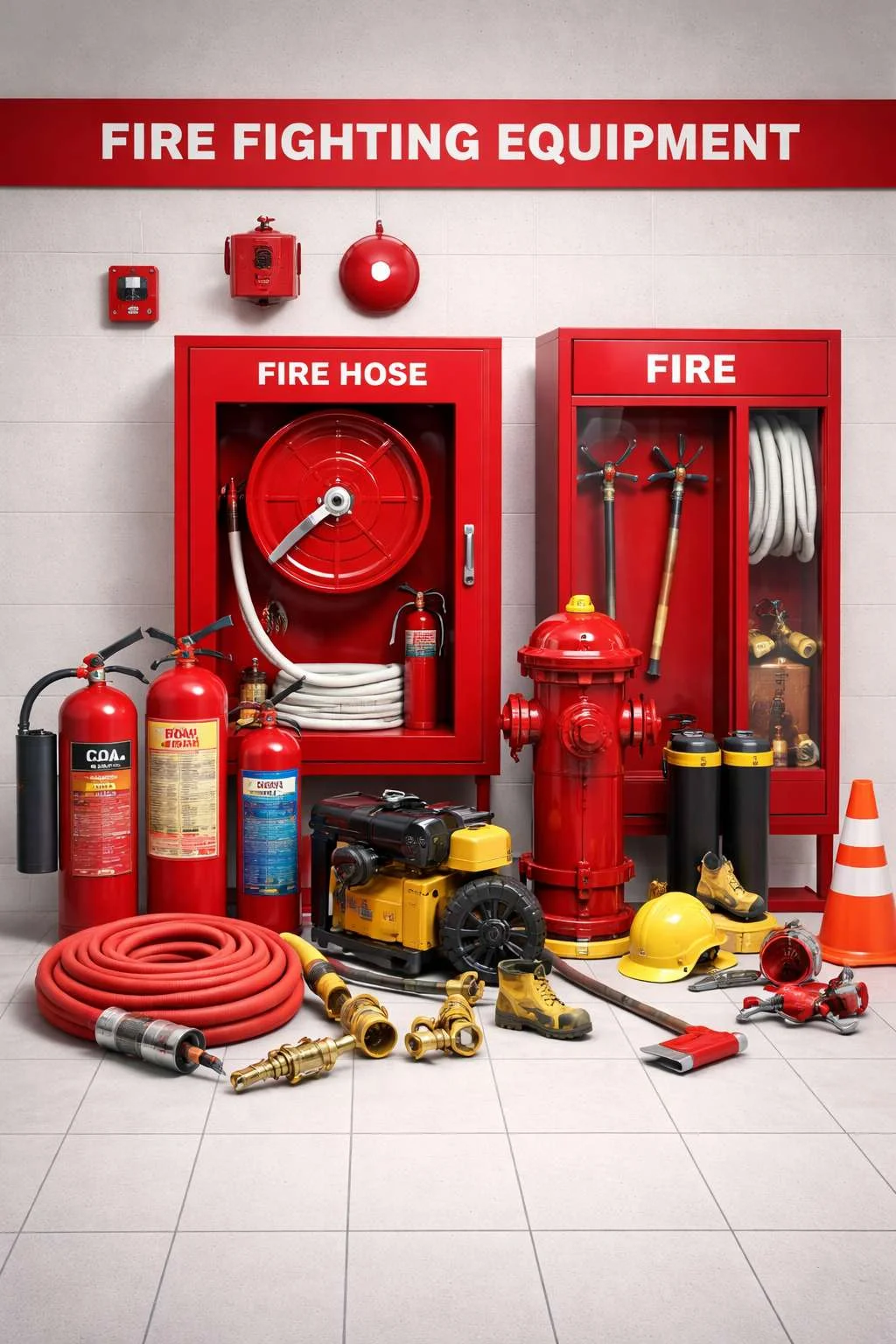
An industrial plant is a dynamic environment that involves machinery, electric equipment, flammable objects, chemicals, fuel, and manufacturing processes. In such a dynamic environment, it is quite easy for a fire to be sparked and grow very rapidly into a full-fledged emergency if not controlled immediately.
This is the reason why an industrial fire safety system becomes a necessity for factories, warehouses, manufacturing units, processing units, power plants, and chemical industry workplaces. Fire protection today is not just limited to portable extinguishing systems. Today’s fire safety requires a complete integration of fire detection and alarm systems, fire suppression systems, fire hydrant systems, sprinkler systems, and maintenance.
An effective fire safety system can do wonders for the plant’s fire safety.
Industrial Fire Hazards
There are various sources of ignitions and fuel at any industrial location. Knowing about the fire hazards present in such a facility is essential to develop a proper fire protection plan.
Some of the fire hazards present in industries are:
- Short circuit and overloading of electric equipment
- Overheating of motors, bearings, and other machinery
- Presence of flammable liquids and gases
- Handling of chemicals
- Use of welding, cutting, and grinding machines
- Presence of combustible dust
- Presence of fuel and oil storage areas
- Presence of hot surfaces and production machines
- Improper storage of combustible items
- Housekeeping and accumulation of wastes
Various types of hazards demand different fire protection systems. For instance, an electrical control room will have a different type of protection system as compared to that required by a warehouse storing combustible materials.
Why Industrial Fire Safety Is Crucial
There may be more to an industrial fire than just material damage. There is a risk of injury or even death for employees due to burns, smoke inhalation or other hazards, financial losses for a company because of equipment damage, disruption of operations, inventory loss, etc.
Moreover, fire may have an impact on business partners, transport connections, and so on.
A proper approach towards fire safety should include both the reduction of fire risks and promptness when dealing with a fire hazard.
Early detection, automatic extinguishing, availability of fire-fighting equipment and trained personnel will help prevent a developing hazard from turning into a disaster.
Early Detection of Fire Is Crucial
One of the key elements of an industrial fire safety system is early detection. It allows taking appropriate measures much faster.
Depending on the conditions, a fire safety system can detect smoke, heat, flames, or any other signs of burning.
Smoke detectors can be useful in appropriate indoor conditions, while heat or flame detectors can be used in particular situations. Various special detectors can be considered for those areas where the use of common detectors is inappropriate.
For instance, high temperature, dust, steam or rapidly developing fire hazard requires special solution of the problem.
The main point here is obvious: detection of fire hazard as early as possible and sending appropriate signal to proper people or devices.
Fire Alarms Help Employees Receive Notifications Right Away
When a fire breaks out, it is crucial for the employees to receive timely notifications about the problem. Fire alarms play the role of communication device.
Audible alarms can inform workers about the problem anywhere in the facility, and visual alarms can be helpful if it is hard to hear due to noise produced by machinery.
It can also be beneficial to have an alarm system which could work with other fire protection devices and systems in the facility.
Testing of the alarm systems is necessary because a malfunctioning alarm system might lead to delays in emergency response and evacuation.
Automatic Fire Suppression Helps To Suppress The Fires Quickly
Fire detection allows receiving the signal, but suppression will help to control or extinguish fire quickly.
Fire suppression systems in industrial facilities can differ depending on types of fires and hazards at the workplace. They can use water, foam, dry chemical, water mist, or gaseous agents.
The advantage of automatic fire suppression systems is that they can activate themselves without any manual actions from people.
This type of system is especially useful when the fire starts in the area where nobody is located, or when there is danger to stay in the area to start the operation manually.
Portable Fire Extinguishers Are a Key Safety Feature
Portable fire extinguishers continue to play a vital role in industrial fire protection. If a fire is identified early and it is safe to intervene, an appropriate fire extinguisher can limit the development of the situation.
However, every fire extinguisher cannot deal with every type of fire. There are specific extinguishing agents that address different fire dangers, including combustibles, flammable liquids, and electrical equipment.
Suitable portable fire extinguishers should be provided at strategic positions in any industrial setting.
It is also essential to train employees properly so that they know how to use extinguishers and equally importantly when to abandon attempts to put out a fire and evacuate.
Fire Hydrant Installations Facilitate Firefighting
Some large industrial premises need to have fire hydrant systems installed to give the firefighters access to the water required for firefighting.
Depending on the design, there may be hydrants, hose reels, valves, piping, pumps, water tanks, and other fire hydrant installation components.
Firefighting connections may be strategically located so that the trained personnel can get access to water at the point of an incident.
Effective operation of a fire hydrant system is contingent on its correct design, sufficient water supply, appropriate pressure, accessibility, and regular maintenance and inspections.
Automatic Sprinkler Systems Help Contain Fire Spread
Automatic sprinkler systems are an important part of fire safety at any industrial site. Properly designed and installed sprinklers are capable of reacting to emerging fires.
Sprinklers are widely used in warehouses, manufacturing facilities, storage facilities, and other buildings where combustible material may be stored.
Sprinkler system design should consider factors such as building structure, storage arrangement, fire risks, ceiling height, and stored materials.
Inspections and maintenance should be carried out regularly to ensure proper operation of valves, piping, sprinkler heads, and other sprinkler system components.
Specialized Fire Suppression Is Required for Hazardous Areas
Some areas within industries may have special hazards which call for specialized fire suppression technology.
For instance, control room areas, electrical equipment, machinery areas, fuel storage areas, and some process zones may require special fire suppression.
In many cases, water will not be a proper fire suppression solution for all applications. Various fire protection solutions may be used including foam, dry chemical, water mist, or clean agents.
Proper risk assessment is needed to understand what kind of fire suppression system would be appropriate for different risks and not use only one solution for the whole facility.
Passive Fire Protection Will Help Slow Down Fire Propagation
Besides fire detection and firefighting equipment, there are also other passive measures that could be used to prevent fire accidents.
Fire-resistant walls, doors, barriers, dampers, and sealed penetrations will slow down fire and smoke propagation from one area to another.
Protected compartments could be arranged inside industrial buildings so that fire in one compartment cannot quickly propagate to other areas.
Passive fire protection will give people more time to leave the facility safely and better conditions for firefighters to handle a fire.
Passive fire protection measures need to be considered along with fire protection systems.
Emergency Shutdown Systems Can Help Reduce Extra Risks
During a fire accident, fuel, gas, electrical, ventilation, or mechanical processes can worsen the situation dramatically.
In some cases, appropriate emergency shut-down systems could be incorporated into fire safety system.
For instance, a system could be built in order to isolate fuel or gas supply, to turn off some machines or electricity when fire conditions arise.
Special engineering measures need to be taken since an unnecessary shut-down of systems may affect operations and incomplete isolation will worsen fire development.
Integration Creates a More Effective Fire Protection System
It is not unusual for modern industrial fire protection systems to use several interconnected systems instead of being independent.
For example, a fire detection system may trigger the fire alarm panel. The alarm will alert the workers while the connected suppression system will react to the fire. In some cases, other systems will execute safety tasks according to pre-programmed procedures.
With proper integration, it will be possible to enhance the response coordination and shorten the response time between detection and intervention.
However, the design and operation of integrated systems will require professional care since all elements should work correctly.
Emergency Plan Will Improve Employees’ Safety
Technical solutions are not enough to ensure full security. Workers should know how to act in case of an emergency.
An industrial emergency plan should list:
Emergency exits and evacuation routes
- Assembly points
- Alarm procedures
- Methods of emergency communication
- Responsibilities of designated personnel
- Location of firefighting equipment
- Contacts of emergency services
Drills will allow employees to get familiar with all this information.
Employees should understand that personal safety comes first. If the situation is too dangerous, then evacuation will be a better choice compared to the attempts to control the fire.
Regular Inspection Keeps Fire Protection Equipment Prepared
Fire protection equipment may lay idle for months or even years, yet its neglect is not acceptable.
Even though the system may look perfectly fine from the outside, it may contain hidden issues such as the damaged equipment, blocked equipment, depleted extinguishing agents, pressure-related problems, electrical malfunctions, etc.
With regular inspection, these potential problems can be discovered before the situation becomes critical.
Depending on the type of the equipment, maintenance may include checks of alarms, extinguishers, pumps, hydrant systems, sprinklers and detection equipment.
Good Housekeeping Lowers Fire Hazards
Industrial fire safety starts with the practice at the place of work.
Combustible garbage, packing materials, oil leftovers, dust, and other unnecessary things can provide extra fuel for fire.
Good housekeeping thus includes:
- Regular removal of combustible garbage
- Clearness of electrical areas
- Control of combustible dust
- Proper storage of flammable materials
- Free access to emergency exits
- Accessibility of firefighting tools
- Cleaning of machinery and adjacent spaces when needed
Cleanliness and good order in the workplace may facilitate hazard detection and limit opportunities for spreading of fire.
Employees’ Training Improves Fire Safety
Employees are often the first who notice signs of smoke, strange smell, sparking or overheating of machines, and other indicators of possible fire hazards.
Employees may be trained to detect such signs and know how to report about them.
Employees must also understand the meaning of various alarms, evacuation routes, emergency assembly places, and the place of firefighting tools.
Employees need training to be supplemented with drills and safety program practice.
Well-trained employees will react more calmly in case of emergency.
Selection of Suitable Fire Safety Equipment for Industry
There is no universal fire safety system which works in all industrial facilities in the same way.
Prior to choosing fire safety equipment, an organization should take into account features of its operations, materials used, building design, employees, storage arrangement, and possible sources of ignition.
Key issues include the following:
Identify Potential Hazards
It is necessary to determine which materials and process are likely to cause or increase the intensity of fire at your facility.
Analyze the Facility Layout
Production spaces, warehouses, electrical room, chemicals storage, exits, machinery and access ways should be considered.
Select Suitable Protection
Detection, alarm, fire suppression, firefighting, and passive fire protection systems should be selected depending on the identified hazards.
Comply with Relevant Requirements
Fire protection equipment should be designed, installed, inspected and maintained according to relevant standards and manufacturer’s instructions.
Long-Term Maintenance Issues
It should be taken into account in designing the fire safety strategy: inspection, testing, service, replacement and training.
The Contribution of Professional Fire Fighting Equipment Manufacturers
Professional fire fighting equipment manufacturer may make an important contribution to fire protection needs analysis of industrial organizations and selection of suitable products.
Depending on the capabilities and product line of the manufacturer, possible solutions may include fire extinguishers, fire hydrant equipment, fire pumps, sprinklers and components, fire suppression systems, alarms and other firefighting products.
Professional consultation may help to determine organization’s needs and select appropriate products based on them.
In case of industrial facility, the target is always to develop fire protection strategy as a whole instead of buying single products.
Benefits of a Comprehensive Approach to Industrial Fire Safety
Several advantages will be obtained by the design of an effective fire protection system.
Protection of People
Timely detection of the fire, alarm systems, evacuation planning, and extinguishing can assist in reducing the exposure to hazardous situations.
Protection of Property
Fire protection will assist in limiting damage to structures, machinery, inventory, and infrastructure.
Business Continuation
Minimizing damage caused by fire reduces the possibility of production disruption and helps businesses operate more efficiently after recovery from an emergency.
Increases Emergency Preparedness
Training, drills, alarms, and defined procedures allow employees to know how to respond.
Fire Risk Reduction
Fire hazard identification, housekeeping, proper maintenance, and suitable equipment will allow eliminating the problem at its root.
Designing a Multi-Layered Fire Protection System
Effective fire protection programs for industrial facilities include multiple layers of protection.
Industrial facilities might have:
- Fire hazard assessment
- Housekeeping
- Detection
- Alarms
- Extinguishers
- Hydrants
- Automatic sprinklers
- Suppression systems
- Passive fire protection
- Emergency shutdown systems
- Employees’ training
- Evacuation planning
- Inspection and maintenance
Each of these layers of protection has a different function. Together, they create a multi-layered approach to prevention, detection, control, and response to fire emergencies.
Conclusion
Fire emergencies in industry facilities can happen very quickly due to the presence of combustible materials, machines, electrical equipment, chemicals, fuel, and high temperatures. Thus, relying on a single type of fire fighting equipment does not provide sufficient protection against fire.
An efficient fire safety plan for an industrial facility implies early fire detection, alarms, fire extinguishing equipment, hydrants, fire sprinklers, fire suppression system, passive fire protection, emergency response planning, staff training, and maintenance of all mentioned components.
The best method of protecting the facility from fire starts with an assessment of the threats and then a development of the layer protection system for specific business needs.
Fire safety equipment installation at any industrial facility is an investment into people, property, continuous operations, and sustainability of the company itself. Proper planning, appropriate equipment, expert advice, and maintenance will help to avoid turning minor fire incidents into an emergency situation.


 English
 Arabic
 Chinese (Simplified)
 Dutch
Dutch French
 German
 Italian
 Portuguese
 Russian
 Spanish