

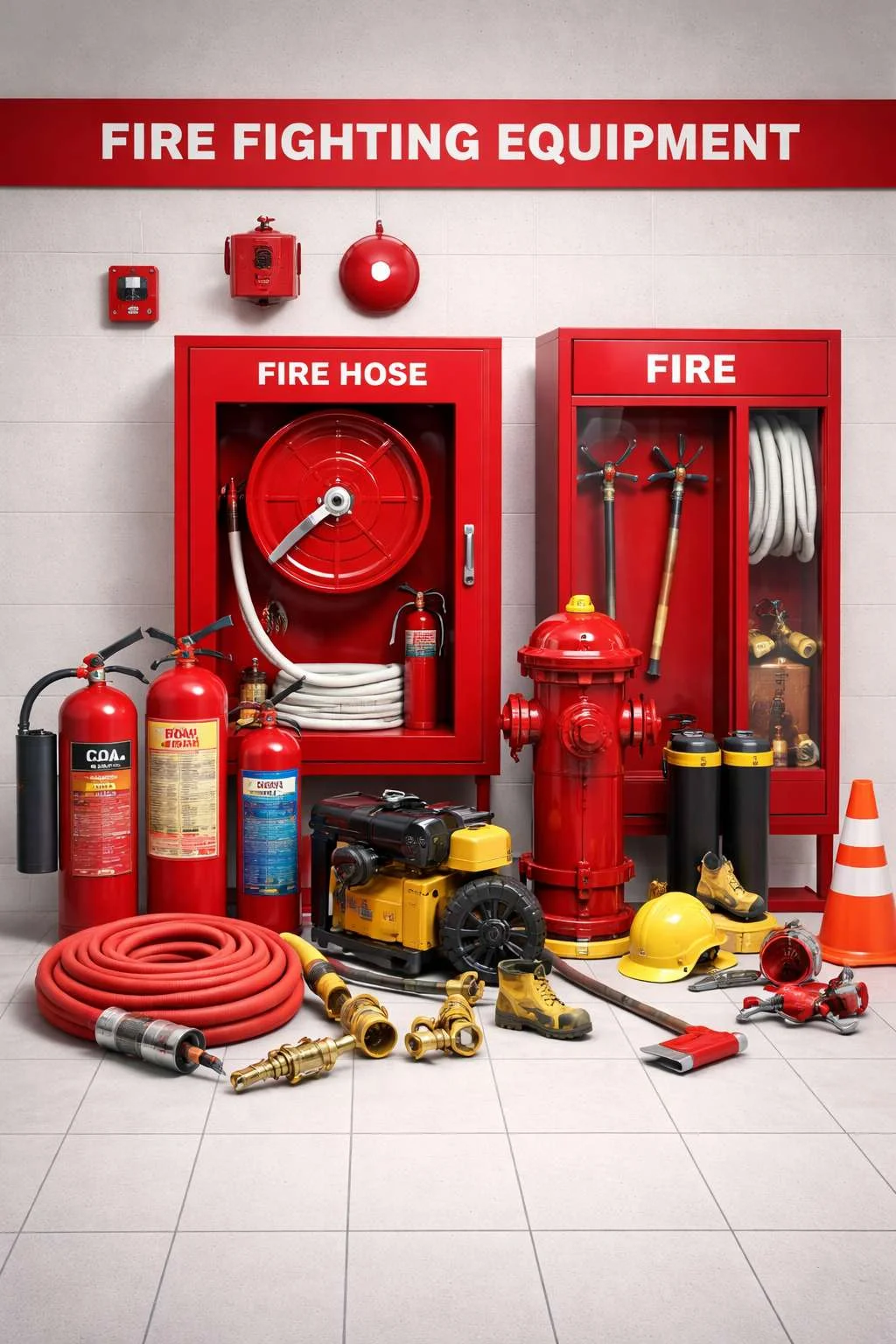
Industrial settings are dynamic environments that are characterized by the presence of machines, electricity, flammable objects and materials, chemicals, fuel, production process, and heated equipment. This creates a lot of hazards and risks if not controlled by the necessary fire prevention and fire safety measures.
Fire that may start from an electrical problem, overheating of machines, chemical reactions, fuel leakage, or any other form of fire can spread quickly through the whole industrial setting. That is why it is very important to have the correct fire fighting system equipment to ensure the safety of personnel, machinery, buildings, raw materials, finished products, and the operation of the business.
An industrial fire protection system consists of fire detection, fire alarm systems, fire suppression equipment, firefighting water system, firefighting equipment, passive fire protection, emergency response, fire safety training, inspection, and maintenance.
This manual highlights the various types of fire fighting system equipment used in industrial settings and discusses how these systems function, their locations and applications, and the importance of maintenance of the fire systems.
What Is a Fire Fighting System?
A fire fighting system is a system of equipment and safety installations that help detect, control, extinguish, and assist in evacuating from a fire.
The equipment used will depend on the nature of the industrial plant, the materials processed, the processes involved, construction of the building, methods of storage, occupancy of the building, fire risks, and safety standards.
A fire protection system in an industrial setting can have:
- Fire extinguishers
- Fire hydrants
- Sprinklers
- Fire pumps
- Fire water storage
- Fire alarm systems
- Smoke detectors
- Heat detectors
- Flame detectors
- Fire hose reels
- Foam suppression systems
- Clean agent suppression systems
- Gas suppression systems
- Fire doors
- Fire resistant partitions
- Emergency lights
- Fire resistant construction
- Emergency communication systems
Thus, there is no one size fits all fire fighting system for all industries. A fire risk assessment needs to be conducted before installing any firefighting equipment.
Importance of Fire Fighting System in the Industries
Fire risks can exist in multiple forms within industries. An industry such as manufacturing industry can have electrical panels, machinery, lubricants, packing material, chemicals, welding machine, fuel and combustible raw material in one factory.
Proper fire fighting systems provide multiple benefits.
Protection of Human Beings
The first aim of the fire safety of industries is protection of human lives.
Fire detection, alarms, emergency exits, firefighting system and employee education can allow employees to act rapidly in case of any accident.
It is essential that employees learn how to give alarm, where to find emergency exits and where to go in case of fire.
Protection of Industrial Property
The machinery and equipment used in an industrial facility may constitute a significant financial burden. Fire may damage the production lines, electrical installations, control equipment, warehouses, materials, and the finished products.
Fire fighting and containment systems may be used to contain the fire and minimize its consequences.
Minimizing the Impact of Business Interruption
The fire at an industrial facility will cause production interruptions, disruptions of supply chain, as well as other negative implications.
The proper fire protection allows reducing the possible negative impacts of the fire-related events.
Rapid Response to an Emergency
Fire hydrants, hose reels, fire extinguishers, fire alarms, fire pumps, and other systems are part of emergency response system.
Regulatory & Safety Requirements
Industries might have national, state, local, building, factory, fire service, insurance, and other special requirements applicable to them.
In India, the NBC 2016 has provisions dealing with fire prevention, life safety, fire protection, exit, compartmentation, firefighting installations, and maintenance.
Applicable requirements must always be based on the specific industries and jurisdictional requirements.
Major Fire Fighting System Equipment Used in Industries
Industrial Fire Extinguisher
Fire extinguishers are amongst the most commonly used portable firefighting equipment in industries.
They are supposed to provide a quick means of putting out any fire which is developing but has not yet escalated into a serious problem.
There are various kinds of extinguishing agents depending on what kind of fire hazards there are. An industry may have:
- Water extinguishers
- Foam extinguishers
- Powder extinguishers
- Carbon dioxide extinguishers
- Clean agent extinguishers
- Extinguishers meant for specific fire hazards
Such as electrically energized fire hazards will need to have extinguishers suited for such an emergency while flammable and combustible hazards will need their own respective extinguishers.
The right extinguisher should always be chosen in consideration of what the danger is.
Fire extinguishers should be placed where they can be accessed easily and also be regularly inspected and maintained.
Fire Hydrant System
Fire hydrant system is one of the major firefighting components in many large-scale industrial facilities.
Unlike fire extinguishers which are portable, fire hydrants offer larger and sustained water flow for fire fighting operations.
Some components in an industrial fire hydrant system are:
- Fire water tanks
- Fire pumps
- Hydrant pipes
- Hydrant valves
- Fire hose
- Branch pipes
- Nozzles
- Hose boxes
- Fire brigades connections
Fire hydrants can be provided either indoors in buildings or in the industrial yards depending on their placement.
These are common in industrial plants, manufacturing units, warehouses, chemical industry, power plants, and other such facilities having higher fire load.
The system needs to be designed to provide suitable water flow and pressure.
Automatic Fire Sprinkler System
Automatic sprinkler systems are extensively employed in industrial buildings, warehouses, manufacturing areas, storage facilities and other places where automatic fire suppression is needed.
The principle of action of the sprinkler systems lies in activation upon overheating due to the development of fire. Depending on the particular design of the system and sprinklers, the water is discharged via activated sprinkler system in order to suppress the fire.
Typical elements of the sprinkler system may include:
- Sprinkler heads
- Pipe network
- Control valves
- Alarm valves
- Pressure gauges
- Water supply
- Fire pumps
- Detection systems
The choice of sprinklers depends on the environmental factors and fire hazard level.
For instance, wet-pipe systems hold the water in the pipes whereas dry-pipe systems use the pressure of air or nitrogen in the part of the pipe where water cannot normally be maintained due to low temperatures.
There are also deluge systems designed for particular fire hazards when a quick discharge over a particular area is required.
The design of the sprinkler system must be carried out by fire protection specialists.
Fire Water Storage Tank
Water is one of the most extensively used firefighting agents in the industrial fire protection systems.
The installation of fire water storage tank will provide adequate water storage for systems such as hydrants and sprinklers where appropriate.
Requirements for the water storage will depend on parameters such as:
- Size of the building
- Fire hazard
- Duration of firefighting efforts
- Hydrant demand
- Sprinkler demand
- Pump capacity
- Standards
Requirements of local authorities
Fire water storage must be thought of within the context of total firefighting system, not as an individual installation.
Tank, pump, valves and piping must be maintained in order to ensure that water storage is available when required.
Fire Pumps
Fire pumps are responsible for providing the necessary pressure and flow for firefighting operations using water.
Fire pumps in the industrial environment could consist of:
- Main fire pump
- Standby fire pump
- Jockey pump
- Electrically driven pump
- Diesel-driven pump
A jockey pump could be used to help keep the system under pressure and make up any pressure loss that might happen.
The main and standby fire pumps are supposed to deliver the necessary firefighting flow when the system works.
Fire pumps are the most important parts of an industrial fire protection system and must be selected, installed, tested, and maintained properly.
Fire protection system efficiency depends on the capability of delivering the necessary water in case of an emergency.
Fire Alarm and Detection System
Early detection is one of the most important aspects of fire safety in industries.
The fire alarm and detection system detects fire or related situations and raises alarms for staff and emergency personnel.
Some of the common components used in a fire alarm and detection system are:
- Fire alarm control panels
- Smoke detectors
- Heat detectors
- Flame detectors
- Manual call points
- Alarm sounders
- Visual notification appliances
- Monitoring modules
- Emergency communication systems
It is necessary to use various fire alarm and detection systems as per the type of industrial environment.
Depending on the environment and nature of fire, some may require the use of smoke detection system while others may require heat detection system. The use of flame detection system could be required where rapid development of an open flame is anticipated.
Aspirating smoke detection systems are advanced detection systems which are capable of sampling air continuously through a pipe network.
Fire Alarm Notification Systems
Fire detection is just the beginning. The personnel needs to be notified promptly.
In an industrial building, there might be a lot of noise due to machines, production lines, compressors, pumps, and many other activities that take place in these buildings.
Therefore, the industrial alarm system might incorporate several forms of notifying people about the alarm, such as:
- High-output sirens
- Horns
- Visual beacons
- Voice evacuation system
- Public address system in case of emergency
- Centralized fire alarm panels
The voice evacuation system can give instructions to employees in cases of emergencies.
The fire alarm control panel serves as the center of fire alarm notifications in different zones of the facility.
Foam Fire Suppression System
The foam fire suppression system is critical where there are potential fires due to flammable or combustible liquids.
They can be utilized in situations such as:
- Petroleum products
- Fuel storage
- Oil handling
- Chemical processing
- Flammable liquid storage
- Selected industrial processes
In a foam fire suppression system, water is mixed with foam concentrate to create foam covering the fire on the burning substance.
The foam prevents contact between the surface of the fuel and oxygen and reduces the chance of re-ignition of the fire when appropriately designed.
Since different fuels require different techniques, foam systems must be designed accordingly.
Clean Agent Fire Suppression Systems
Water is not always the preferred method of fire protection for all industrial settings.
There are instances where water can do more harm than good due to the presence of sophisticated electronics and control devices.
There are certain settings which might warrant the application of clean agent suppression system such as:
- Control Rooms
- Server Rooms
- Electrical Rooms
- Instrumentation Rooms
- Telecommunication Rooms
- Data Centers
Clean agent suppression systems utilize gaseous fire suppressing agents that have been developed for certain protected spaces.
The design of clean agent suppression systems requires proper engineering because a lot of considerations need to be taken into account.
Fire Hose Reels
Fire hose reels offer an easily available system of delivering water in cases where they are mandated.
Such fire hoses could be helpful in dealing with the right type of developing fires by trained people.
In order for such hoses to operate effectively, hose reels must be:
- Identifiable
- Accessible
- Unobstructed
- Well-connected
- Inspected regularly
- Operational
The staff should only make use of firefighting equipment if they are well-trained in doing so without putting themselves at unnecessary risks.
The evacuation of the fire site should always come first in case it is impossible to control the fire.
Passive Fire Protection Systems
Fire protection cannot solely rely on active fire fighting appliances.
The passive fire protection method is built into the building itself to help control and protect against the spread of fire and smoke.
Some of these measures are as follows:
- Fire rated walls
- Fire doors
- Fire rated floors
- Fire stopping
- Compartmentation
- Smoke barriers
- Fire rated cable penetration
- Fire dampers
- Fire rated structural protection
Passive fire protection helps prevent fire from quickly moving from one part of the facility to another.
For instance, fire rated compartmentation helps in separating the high risk areas from other parts of the building.
Also, intumescent coatings can be put on certain steel structures. This material swells when heated and forms a protective layer on the metal.
Fire Detection Technologies Used in Industrial Facilities
There are various types of technologies that can be used in industrial fire protection.
Smoke Detectors
The smoke detectors are used to detect smoke particles from an existing fire.
They may be appropriate in specific parts of industrial facilities if environmental conditions do not create many false alarms.
Heat Detectors
The heat detectors detect temperature changes.
They may be helpful in environments where dust, steam, or fumes make smoke detectors not appropriate.
Flame Detectors
The flame detectors detect radiation emitted by flames.
They are helpful in cases when the fire develops quickly in certain environments, such as fuel handling or process facilities.
Aspirating Smoke Detection
Aspirating smoke detectors actively take air samples from sampling tubes to detect smoke particles. Such systems can detect the fire very quickly if they are applied properly.
Installation of Fire Fighting Systems in Industries
There are several factors that need to be taken into account while installing fire protection equipment in an industry.
Installation of fire protection equipment just because of the presence of fire extinguishers or just because of pipes will not offer sufficient protection.
Installation of fire protection equipment usually follows several steps:
Step 1: Fire Hazard Assessment
The first step of installation of fire fighting system includes identifying potential ignition sources, flammable substances, hazardous processes, machinery, electrical equipment, etc.
Step 2: Identifying Fire Hazards
Different departments in the same industrial premises may have entirely different fire hazards.
Therefore, a production floor, chemical storage room, electrical room, storage place and office premises may have different ways to protect themselves from fire.
Step 3: Selection of Fire Fighting System
Selection of the suitable fire protection system should be done based on the identified risks.
Step 4: Engineering Calculations
Water based fire protection systems require engineering calculations related to flow, pressure, size of pipe, pump capacity, water storage, etc.
Step 5: Installation of Equipment
Fire protection equipment installation must be done following proper engineering calculation and manufacturer guidelines.
Step 6: Testing and Commissioning of the System
The installation process is not complete until the system is tested to confirm that all the components are working as they should.
Step 7: Training the Employees
The employees need to know how to respond in case of a fire emergency.
Maintenance of Fire Fighting Equipment for Industrial Uses
A fire protection system is not just a one-off investment.
Even the most well-designed systems can fail to function effectively if regular inspections, testing, and maintenance are not conducted.
The maintenance plan needs to take into account such fire fighting equipment as:
- Fire extinguishers
- Fire pumps
- Hydrant valves
- Fire hoses
- Hose reels
- Sprinkler valves
- Sprinkler piping
- Fire alarm panels
- Smoke detectors
- Heat detectors
- Manual call points
- Water storage tanks
- Foam systems
- Emergency lighting
- Fire doors
- Emergency communication systems
Visual inspections can detect various problems such as clogged equipment, damaged components, low-pressure extinguishers, blocked emergency exits, or any other visible problem.
Testing must be done according to the frequency set out in the applicable standards and/or maintenance plan for your facility.
Specialized inspection, testing, servicing, and commissioning must be carried out where necessary.
Employee Fire Safety Training
Fire fighting equipment alone is not enough to ensure industrial fire safety.
The workers need to know how to respond during emergencies.
Industrial fire safety training should include:
- Raising fire alarms
- Evacuation during emergencies
- Emergency exits
- Assembly points
- Fire safety techniques
- Introduction to fire extinguishers
- Emergency communication
- Reporting hazards
- Responsibilities of emergency response teams
Fire drills can aid in familiarizing the workers about the evacuation process and deficiencies in the emergency response plan.
Training should also be relevant to the workers’ job functions. The workers responsible for using particular fire fighting equipment should have suitable training.
How to Select the Right Fire Fighting System for an Industry
There is no single fire protection system that will work for all industrial facilities.
In order to select the appropriate fire fighting system equipment, some considerations need to be taken into account.
Type of Industry
The first step is the nature of the industrial process involved.
Textile industry, chemical process industry, warehouse, pharmaceutical industry, power generation, and oil tank farm are quite different in terms of fire hazards involved.
Type of Fire Hazard
This can range from combustible solids, flammable liquids, gases, electrical appliances, combustible dust, chemicals or special process fire hazards.
Layout of Building
The size, height, layout of floors, access route, storage areas, and layout of compartments can make differences in fire protection requirements.
Storage Conditions
These include the amount, type, height, density, and layout of stored materials.
Environmental Conditions
These include dust, humidity, temperature, corrosive environment, steam, and many other environmental conditions.
Relevant Standards
Every industrial facility should know the relevant national, local, building, fire service, industry specific and other standards.
There may also be international standards such as NFPA standards relevant depending upon the project and other requirements.
Maintenance and Serviceability
The equipment selected must not only be appropriate for installation but also suitable for inspection, testing, maintenance, repair, and replacement during the entire service period.
Conclusion
There is a need for an integrated method of protecting against fires in industries rather than relying on one particular firefighting device.
Fire extinguishers, hydrant systems, automatic sprinklers, fire pumps, water tanks, fire alarms, smoke and heat detectors, flame detection systems, foam suppression, clean agent systems, hose reels, fire doors, and passive fire protection all have unique uses in an effective fire protection system.
Effective fire protection is achieved through the integration of prevention, detection, alarm, active suppression, passive fire protection, evacuation, education, inspection, testing, and maintenance.
The equipment needed should be identified considering the hazard involved in a particular industry and not simply from a general checklist. Fire safety systems used in a chemical processing plant, warehouse, manufacturing plant, power station, and oil depot are likely to be very different.
Above everything else, fire fighting equipment must always work and be available. Inspection, testing, maintenance, employee training, and drills are key components of a good fire protection system.
In the case of industrial establishments, putting money into a good fire fighting system translates to more than just protecting their facilities but ensuring that their employees are protected as well.
The role of a good fire protection engineer in designing the right system for your facility includes assessing your facility, recognizing the relevant requirements, designing the appropriate system, installing, testing and maintaining the system. With the appropriate fire fighting technology, engineering, processes and professionals, the industrial facility becomes much more capable of responding to a fire in an effective way.


 English
 Arabic
 Chinese (Simplified)
 Dutch
Dutch French
 German
 Italian
 Portuguese
 Russian
 Spanish